
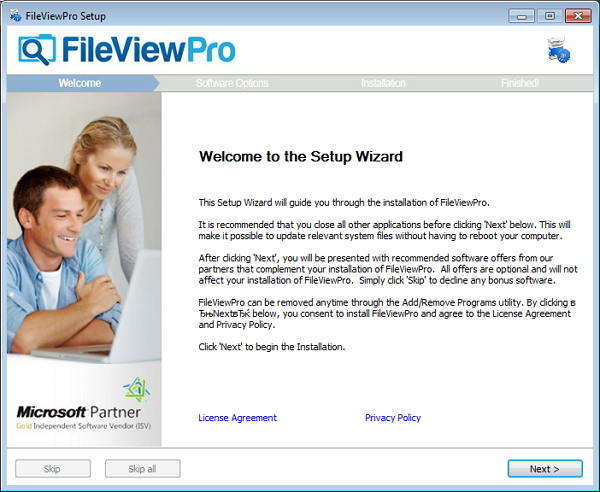
The .AI file extension typically denotes an Advantage Database Server index file that keeps structured lookup data tied to tables registered in an ADS data dictionary. Instead of storing user records directly, the AI file maintains sorted key lists and pointer structures that ADS uses to quickly locate rows, enforce relationships, and accelerate queries against the underlying data files. In typical use, AI files are produced and updated transparently by ADS, which can regenerate the index content if needed when the related data dictionary is loaded. Because AI files are tightly coupled to the internal workings of ADS, they are not meant to be edited by hand and are usually accessed only through official Advantage tools and client applications. If you liked this write-up and you would like to obtain much more details with regards to advanced AI file handler kindly stop by the web-site. If you no longer have Advantage Database Server installed, a multi-format viewer like FileViewPro can be used to recognize the AI extension, show core file properties, and sometimes reveal low-level data, helping you decide how to handle or migrate the database index file.
A database file is a purpose-designed file used to contain and control structured information so that applications can search, edit, and process it with speed and reliability. On the surface, it may look similar to a table of rows and columns like a spreadsheet, but internally it uses indexes, pointers, and metadata so huge volumes of information can be searched and updated without slowing to a crawl. Instead of scattering information across many separate documents, a database file centralizes it in a single, consistently structured storage system. Applications connect to these database files through a database engine, which understands the internal format, handles reading and writing, enforces rules, and keeps everything synchronized when many users or processes are active at once.
The history of database files goes back to early mainframe days in the 1960s and 1970s, when businesses shifted their records from paper to magnetic storage media. Early systems relied on simple flat files where every record had the same layout, and software often had to scan the entire file just to find a single piece of information. As organizations accumulated more data and needed richer reports, flat file systems became a bottleneck, leading to hierarchical and network databases and finally to relational databases that store data in related tables accessible via SQL. As technology matured, the ecosystem exploded with proprietary and open database file formats, spanning everything from lightweight, single-file databases to extensive multi-file systems operating in enterprise environments. Every advance in storage media, whether floppy disks, spinning hard drives, solid-state devices, or cloud object stores, shaped the evolution of database file formats, driving them toward higher speed, greater scale, and improved durability.
Database files are essential because modern applications need consistency, speed, and reliability when working with constantly changing information. If data were scattered across dozens of documents and spreadsheets, coordinating changes among different users and components would quickly become chaotic and error-prone. Database file formats are specifically designed to handle concurrency, crash recovery, and data integrity, ensuring that updates are either fully applied or not applied at all. Behind the scenes, these files maintain transaction logs, checkpoints, and indexes that let systems detect conflicts, roll back incomplete work, and restart after failures without losing committed data. In practice, companies benefit from a stable foundation where key data like transactions, stock levels, and client records remain trustworthy despite traffic spikes and occasional system failures.
Modern database files are often used in sophisticated ways that reach far beyond classical tabular data. Today’s databases frequently embed support for rich data types, including JSON and XML documents, geographic and spatial information, multimedia content, and numerical vectors for AI models. Their underlying file structures and indexes are optimized so that you can search by location, nested fields, or similarity without reading the entire dataset. In large distributed deployments, multiple machines hold their own versions of the database files, and replication mechanisms work behind the scenes to keep all copies consistent. This replication enables high availability and fault tolerance, because if one node fails, another can take over using its own copy of the files, minimizing downtime. Some systems adopt log-structured or append-only file designs, which make writes very fast, simplify backups, and even support time-travel queries that let users inspect the data as it existed at earlier points in time.
Common uses of database files are woven into almost every digital activity, even though most users never see them directly. When you log in to a website, your credentials, preferences, and session details are almost always stored somewhere in a database file. Food delivery apps, ride-sharing platforms, and messaging services constantly interact with database files to keep track of users, transactions, locations, and message histories. In retail, point-of-sale terminals use database files for catalogues, pricing, inventory, and sales, and in finance, secure databases record balances, transfers, and audit trails. Even smaller desktop tools such as personal finance apps, note managers, and media libraries often embed a compact database and save everything into a single portable file on your device, making backups and migration much easier.
Another major theme in the development of database file formats is the ongoing trade-off between speed and portability. A number of database file formats are tightly coupled to the database software and environment they run on, enabling great efficiency while making migrations more complex. Conversely, some formats emphasize being fully self-contained, making it simple to move one file between machines or archive it for long-term storage. You see the same tension in compact embedded databases used on phones and IoT devices and in large clusters that manage thousands of data files across storage arrays. Across all these scenarios, thoughtful file-structure design is what allows databases to stay fast, robust, and interoperable as technology changes.
In the years ahead, database file formats will continue to adapt to enormous datasets and complex workloads shaped by cloud platforms, big data analytics, and AI. Many cloud-native databases place their files on distributed object stores rather than directly on a local disk, but applications still expect a unified, coherent view of the data. These conditions are pushing designers toward novel file organizations and storage engines that yield lower access times, better compression, and more efficient use of infrastructure. In big data pipelines and warehouses, columnar storage formats shine because they only load necessary columns and compress repeating values tightly, accelerating queries over huge datasets. New storage devices with very low latency are pushing database designers to rethink file structures so they can fully exploit performance gains but still guarantee durable, crash-safe writes.
Rising expectations around data security and privacy are pushing database files to include built-in encryption and more detailed access rules right where the data is stored. Rather than relying solely on external protections, many systems now encrypt data at rest, including the database files on disk, so that stolen media cannot be read without the appropriate keys. Tomorrow’s systems are expected to support increasingly fine-grained encryption policies, protecting certain fields or records differently and leveraging dedicated hardware to safeguard key material. Regulatory demands around personal data, including the ability to erase or anonymize records, are shaping how database files implement safe deletion and masking without undermining consistency.
In the end, database files continue to be a core foundation of the digital world, silently organizing and protecting the data that systems depend on. Whether they appear as tiny embedded databases inside mobile apps or as huge clusters of files powering international cloud platforms, they enable both simple and highly complex applications to function. As technology advances, database files will continue to evolve, meeting demands for scale, complexity, privacy, and speed, yet remaining flexible enough to serve the everyday needs of people and software alike.